Spring has sprung! Ornamental trees are blooming, flowers are growing and insects are awakening.
One such insect super active every spring and summer is the carpenter bee. Carpenter bees are prevalent throughout the United States and active in every state. Although there are different species, the most common is big and resembles a bumble bee. You may find it foraging around flowers, shrubs and under the eaves of buildings. This bee is unique from most because it will bore into wood to make its home. Carpenter bees are a nuisance and can cause damage to any wood on your property. They also bother homeowners by “attacking” them though they rarely sting. To keep your building free of carpenter bees, you must know their biology and habits.
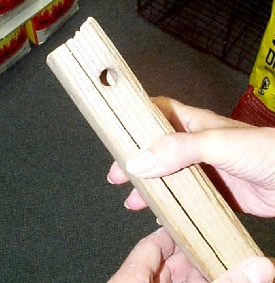
Carpenter bees bore holes into wood overhangs, fence posts, and trees used to lay eggs and essentially create nests. They will also crawl under the cracks of of homes siding and roofing to use these tight spaces for nests. When they bore in wood, the hole they drill is about 1/2″ wide and very round, much like one can make using a drill. This hole will go in straight an inch or two and then turn 90 degrees. The following video shows close up a freshly drilled hole with a female carpenter bee just inside.
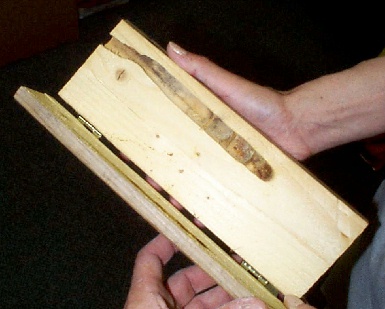
Just off the main corridor, females will bore segments used as egg chambers. Eggs are laid at the end of these chambers and many times in “sub” chambers which can develop over time when nests have been recycled.
Females with then gather food and store it alongside the egg. These chambers are then capped and sealed tight. It is common for a nest to be two or more feet long with 10 or more sub chambers. Here is what a typical carpenter bee nest would look like from the outside.
And if you could peer inside the hole, the drilled out chamber would look like this.
Typically the female carpenter bee will do all the drilling and nest maintenance. At night she will stand guard at the nest entry hole. She will defend the nest aggressively and females are armed with a stinger.
Once her drilling is done, she will spend her days foraging for food. You may find her working Azaleas, Bradford Pears, Daffodils, Pansies and any plant that might provide pollen used to feed her brood.
Male bees will be hanging around the same plants females use hoping to find a receptive female who is interested in finding a mate. The male bees are naturally curious and will buzz around anything including people, pets and most anything they see moving. This buzzing scares people into thinking they are being “attacked”. Ironically the male bee does not have a stinger and is completely harmless. He has a distinctive yellow face, which may be seen while he is in flight; females have a solid black face and will not be interested in people or pets.
Female bees are less likely to be seen and for the most part, spend their time working on nests and collecting food. For this reason they will routinely be active where bumble bees forage. And since the two look similar, its easy to confuse a carpenter bee with a bumble bee but there are two main differences.
First, carpenter bees are generally larger.
Second, carpenter bees have an abdomen which is shiny, metallic and black in color. Their abdomen has no body hair. Bumblebees have yellow and black body hair on all body parts. The following video shows a female carpenter bee closeup as she is chewing an entrance hole to a newly formed nest. Note her shiny metallic abdomen (bottom half of her body).
In addition to “attacking” people and pets, carpenter bees are a problem because they will readily return to the same wood or location where they were born. Old nests are used year after year and offspring will often times construct nests alongside old nests. For this reason a single nest one year will become two or three the following year. Problems rapidly escalate and soon you may have hundreds of holes.
When you have numerous carpenter bee nests, you will have numerous larva. The larva of carpenter bees is large, noisy and “nutritious”. They make enough noise to attract a range of predators including woodpeckers. Buildings which have woodpeckers damaging exposed wood probably have some type of larval activity one of the most common larvae found to attract damaging birds is the young carpenter bee.
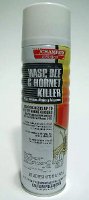
To get rid of carpenter bees, you must think long term. The nuisance male bees are easy to kill with BEE AND HORNET FREE.
To use this approach efficiently, you’ll need to get as close to them as possible and then spray directly at them making sure to keep the spray on them as long as it takes to knock the out of the air. This is will generally take a good 3-5 seconds.
Bee and Hornet Freeze is fast working and will control any large wasp, bee or other insect. It can reach up over 20 feet and works immediately providing fast relief when the local numbers hanging around are too high so use some to reduce foraging males seeking a mate.


Unfortunately, killing the male bee will do nothing to stop the local infestation or to break the cycle of bees coming back to your home to nest. So to accomplish this goal, you’ll need to treat the nest with a material which will last a long time. This ensures it will be around when larvae hatch which might not happen for 6-12 months (depending on where you reside). Remember, the eggs are buried deep in the nest and are well protected so liquids will not kill them. This means to get a long term “permanent” solution, you’ll need to use an agent that will last for many months after its been applied. For this reason, you’ll need to use a dust and not any kind of dust will do.
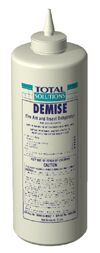
To insure complete control, you’ll want to use DEMISE DUST. This light “talc like” dust has a desiccant (dehydrating) action allowing it to work mechanically on target pests. So when applied into a live nest, it will quickly kill any adults inside. But because it can last for over a year, hatching larvae will fall victim to it as well.
To treat any nest, you’ll need to puff Demise into the hole giving the applicator a good 3-4 squirts. This is easy to do and will take 2-3 seconds.
The small 6 oz size is enough to treat 25-50 holes. The 1 lb jar is enough to treat 50-100 holes. Once dusted, leave the holes open for one day to ensure you get all the bees using the nest.
$35.00 (3.5 oz jar) (452885)
Order online and save 5%
$50.00 (6 oz jar) (452832)
Order online and save 5%
So what if the nests are deep and you want to fill it with caulking so it will be preserved? Well that would be bad. Remember, the egg chambers are sealed and no dust or regular liquid can penetrate them. This means the eggs or developing pupae will be hatch in the future and when they try to come out, they’ll be forced to drill new holes if you’ve filled their old tunnels.
So if you only dust, the best way to seal them is by plugging the holes with our 1/2″ CORK. This way once they exit their protected chambers, they’ll surely crawl through the Demise and kill themselves.
In general, our 1/2″ cork will cover most holes. This is because their long and tapered. The bottom edge is close to 3/8″ and they taper up to 1/2″. This way if if the hole is on the small size, the bottom will fit and even if you can’t fit it all the way in, you can trim it down to fit flush with the surface of the wood. This will seal the tunnel tight thus protecting the dust but also look fine for cosmetic reasons. But since most holes will be nearly 1/2″, you should be able to push them in nice and tight for a perfect fit.
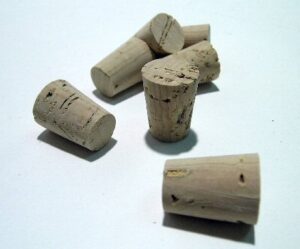
$20.00 (Bag of 100)(286326)(FREE STANDARD SHIPPING)
Order online and save 5%
* AGAIN – DO NOT FILL AND SEAL ANY TUNNELS WITH SILICONE UNLESS YOU PLAN ON POWER INJECTING! *
So in general, using any kind of “silicone” is a huge mistake as is any other kind of wood filler to completely “fill” any gallery or tunnel so in general, its best to leave them open and just cap them. This is due to the emerging young. If they come out of their egg chambers and encounter the dust, they’ll be controlled. But if those chambers are filled with caulking, they’ll drill and this could lead to them getting inside the home which would be bad.
Now there is a way to kill all stages of activity that could be in any one nest. And this would allow you to fill any hole with silicone or wood putty with confidence. Using our POWER INJECTOR, you could mix up some MAXXTHOR EC (scroll down to order) and BASE OIL. This combination will penetrate any nest. In fact it will move through wood like a hot knife through butter killing all insects along the way.
Base Oil is a special penetrating agent. Used by professionals to treat wood for pests like TERMITES or POWDER POST BEETLES, Maxxthor EC will kill every stage of any insect in any kind of soft of hard wood in a few minutes.
When used in Carpenter Bee holes, it will end all stages so you can fill their tunnels and paint without fear of anything coming out months later. This could be especially helpful if you’re having the home professionally painted and you want the painters to do the complete job.
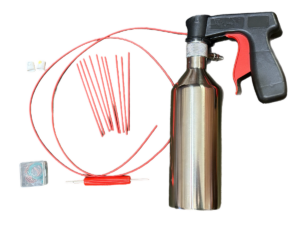
$85.00 (283168)
Order online and save 5%
You’ll need Base Oil to deliver the Maxxthor where it counts. A quart will be enough to treat 15-25 nests/tunnels. We offer Base Oil is quarts, 1/2 and full gallon jugs.

$25.00 (455251) Quart (32 oz)
Order online and save 5%
$40.00 (455253) 1/2 gallon (64 oz)
Order online and save 5%
$60.00 (455258) 1 gallon (128 oz)
Order online and save 5%
Since carpenter bee holes can penetrate several feet, you will need to use a special applicator to “puff” the dust into their entrance and a good unit for the job is the CRUSADER HAND DUSTER. This tool has a small rubber cap you’ll remove and then fill about 3/4 of the way with dust before using it. All it will take is 2-3 puffs to get the job done so there is no need to “fill” the nest with Demise. Once dusted, expect to hear bees buzzing before falling out opf the nest to die.
$25.00 6″ Model (282244)(Free Standard Shipping)
Order online and save 5%
The following video shows how to dust a hole and what to expect after its received a good dose.
Once a home gets just one carpenter bee nest, its more likely to get more in the future. The reason this happens is complex.
First, existing holes will release pheromones and other odors which tell nearby females your home is a good location on which to nest. These same smells are what lure male bees to the area. The good news is that a thorough dusting with Demise will dramatically remove these smells. But ensure it helps as much as possible, dust under all siding and other cracks and crevices and not just the holes you see. This effort will really help reduce the amount of new bee activity.
Second, bees which were born in nests on your home are pre-wired to use the same area they were born on to either use old nests or build new ones. So if one hole generate 5 females, you could end up with 5+ holes in the second year of the infestation.
Third, if you home gets a nest its because carpenter bees are naturally drawn to the home in the first place.
For all of these reasons, homes which get just one nest are likely to keep getting them even after you dust so to make sure this doesn’t happen, you’ll need to spray the exterior of your home 1-2 every spring with MAXXTHOR EC
This active is highly repellent to most any insect and is especially bothersome to carpenter bees.
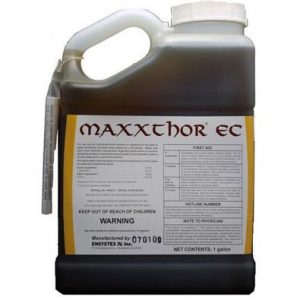
Mix it at the rate of 1/2 ounce per gallon and apply the gallon over 500-800 sq/ft. This application rate works well when treating cedar homes and log cabins too. These structures are particularly subject to carpenter bees so you’ll need to treat all surfaces under the overhang of the roof. On traditional homes made brick, you can generally focus your attention on the soffits and trim boards. But on vinyl or aluminum siding, you may have to spray all surfaces if the bees have been foraging under the covering.
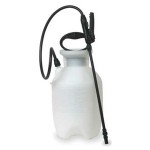
Spray the home using any standard PUMP SPRAYER. Our sprayer can reach up to 20 feet so for single level homes, it can usually handle the job well.
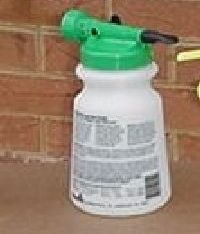
To reach higher heights, use our HOSE END SPRAYER. This sprayer uses the power of your garden hose and in most cases, will be able to reach up 30 feet or more.
Order online and save 5%
Give us a call if you need further help. Our toll free is 1-800-877-7290 and we’re open Monday through Friday, 9:00 AM to 5:00 PM and on Saturday, 9:00 AM to 2:00 PM (Eastern Standard Time).
Email questions here: https://www.bugspray.com/about-us/contact-us
Order online and get a 5% discount! We ship fast with 99.9% of all orders shipping within 1 business day!!
Learn more about BUGSPRAY.COM and why it’s never been easier or safer to do your own pest control.
Please show your support for our business by purchasing the items we recommend from the links provided. Remember, this is the only way we can stay around to answer your questions and keep this valuable web site up and running. Thanks for your business!
Here are direct links to all the products listed in our article:
https://bugspray.com/catalog/insecticide/dust/drione-demise-dust-6-oz
https://bugspray.com/equipment/equipment-plugs/cork-12
https://bugspray.com/equipment/dusters/crusader
https://bugspray.com/equipment/dusters/dustick
https://bugspray.com/equipment/sprayers/bugspray-power-injector
https://bugspray.com/catalog/insecticide/liquid/deodorized-oil
https://bugspray.com/catalog/insecticide/liquid/maxxthor-ec